A low price per square foot does not tell you whether the stone will arrive in the promised thickness, finish, quantity, or batch consistency. By the end, you will have a practical way to verify a supplier, compare delivered costs, approve a representative batch, inspect the delivery, and protect your project schedule.
Key takeaways
- Ask for sourcing details, processing capabilities and delivery evidence.
- Put dimensions, finish, tolerances, quantity and delivery date in writing.
- Compare the delivered-and-installed cost, not only the stone rate.
- Inspect the approved batch before installation begins.
Verify the supplier before you approve the order
A supplier is equipped for your project only when it can prove consistent sourcing, accurate processing, and reliable delivery—not merely display an attractive sample. To verify a Kota stone supplier, test its claims against your required quantity, dimensions, finish, and installation schedule.
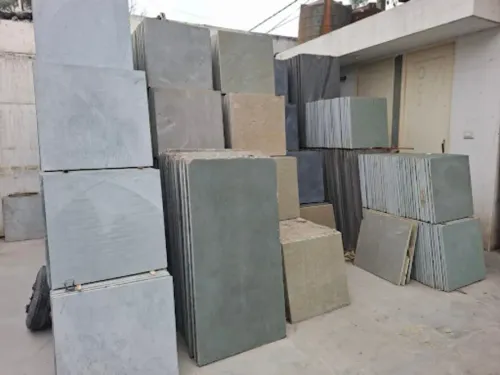
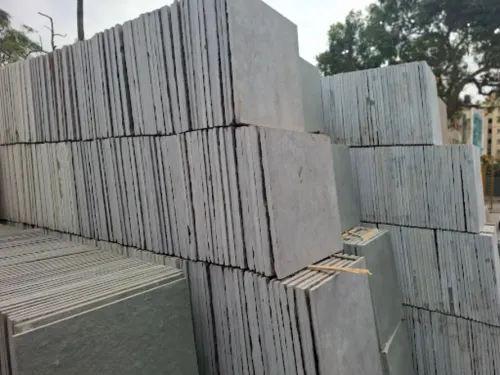
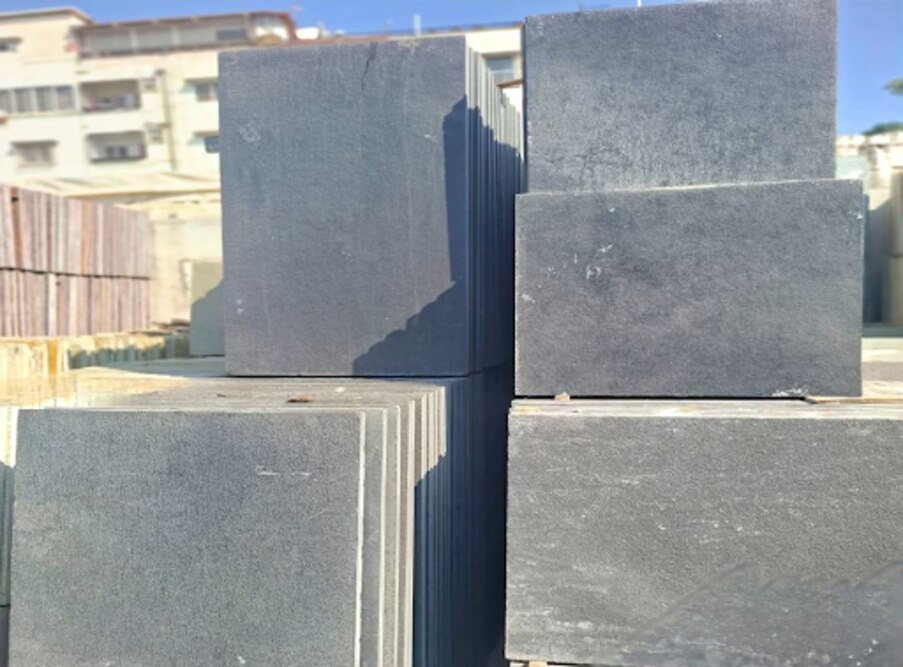
1. Ask for the Kota stone source, quarry area, and the date or lot from which your material will come. A small sample cannot prove batch uniformity: Kota limestone ranges from blue-grey and greenish-grey to brownish tones, with variation between blocks and production lots.
2. Request a physical sample showing the proposed thickness, calibration, surface finish, edge treatment, and colour range. Check whether the supplier can produce the required quantity with matching dimensions, rather than substituting uncalibrated pieces that demand extra bedding and sorting.
3. Arrange a quarry inspection or visit the cutting and finishing facility. Look for stocked blocks or slabs, calibrated cutting equipment, safe packing, covered storage, and enough loading capacity for your delivery schedule. Ask how damaged pieces are segregated before dispatch.
4. Confirm the supplier business address by visiting it or checking that it appears consistently on the quotation, tax invoice, website, and transport records. A supplier who cannot show a traceable operating location is a poor choice for a large advance payment.
Before approval, ask for references from comparable flooring or construction projects and inspect a completed installation. That reveals whether the supplier handles colour variation, replacements, and delivery problems after payment.
Put every technical and commercial detail in writing
A written Kota stone quotation must identify the material, scope, and liability before you pay an advance. Do not accept “standard Kota” as a complete specification: stone grade, finish, quantity, price basis, tax, transport, and installation inclusions all need named terms.
Request these documents and entries:
- State the intended use, support condition, finished thickness, thickness tolerance, Kota stone dimensions, squareness, calibration, and whether measurements are nominal or actual.
- Record the surface finish, edge treatment, cutting, polishing, stair tread and nosing details, risers, skirtings, thresholds, drainage falls, and matching requirements.
- State the stone grade or selection description, approved sample or batch reference, calculated quantity, wastage allowance, packing method, delivery address, unloading responsibility, and delivery date.
- Ask for water absorption, apparent specific gravity, porosity, and strength results, or a written test plan referencing IS 1124 and the applicable IS 1121 compressive-strength test.
- Specify the proposed sealer, colour or sheen change, drying time, and whether sealing is included. Sealing reduces penetration; it does not prevent acid etching or substrate moisture damage.
- Include GST details, a tax invoice, payment stages, cancellation terms, inspection rights, replacement terms for cracked, warped, chipped, wrongly sized, or mixed-batch stone, and the process for resolving shortages.
| Term | Write into the order | Why it matters |
|---|---|---|
| Price | Per square metre or piece, plus GST and freight | Prevents an artificially low comparison |
| Delivery | Date, unloading point, and damage responsibility | Fixes responsibility in transit |
| Replacement | Inspection period and replacement timeline | Protects the advance payment |
Compare quotations by delivered-and-installed cost
Start by converting each quote to one delivered-and-installed total. A Kota stone price comparison fails if one supplier quotes 18-mm honed tiles and another quotes 20-mm calibrated slabs. Record the exact thickness, finish, size, grade, quantity, and cutting pattern before comparing totals.
| Cost item | Quote A | Quote B | Compare on |
|---|---|---|---|
| Stone | Rate per square foot and stated thickness | Rate per square foot and stated thickness | Same thickness, finish, dimensions, and selection |
| Quantity | Net area plus wastage allowance | Net area plus wastage allowance | Recalculate from the same cutting layout; room geometry and patterns change waste |
| Logistics | Packing, transport charges, unloading | Packing, transport charges, unloading | Delivered to your site, including floor access and lifting |
| Installation | Cutting, laying, joint filling, skirting, sealant | Cutting, laying, joint filling, skirting, sealant | Identical scope and measured quantities |
| Tax | GST shown separately | GST shown separately | Add GST to both totals before deciding |
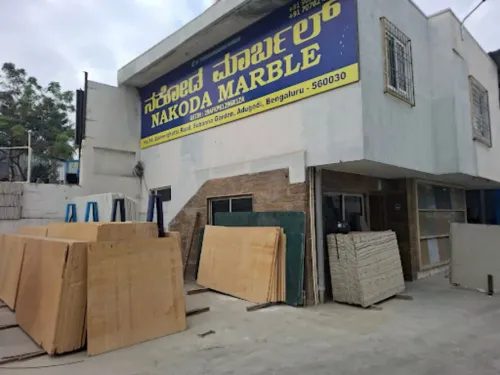
Ask Nakoda Marble, as you would any Bengaluru supplier, to issue these as separate line items rather than one bundled square-foot rate. Hidden exclusions create the real difference: a low quote can omit edge cutting, staircase work, skirting, sealant, or breakage replacement.
Check the technical basis too. Request test results or a test plan for water absorption, apparent specific gravity, porosity under IS 1124, and compressive strength under the applicable IS 1121 test. Reject any “cheaper” option that changes the stone specification without showing what performance you lose.
Related product
 | natural stone focuses on its natural strength, earthy appeal, and versatility for high-traffic areas, with key export considerations including durability, finish... View product → |
Choose the supply format and quantity for the installation
Choose Kota stone tiles for rooms with regular dimensions and a straightforward grid. They reduce on-site cutting and are easier to replace later. Choose Kota stone slabs for large open floors or layouts where fewer joints matter, but allow for heavier handling and more cutting waste.
Use custom-cut Kota stone for borders, stairs, circles, diagonal patterns, or rooms with many corners. Confirm whether the price includes calibration, polishing, cutting, edge finishing, packing, and matching.
| Option | Best fit | Main trade-off |
|---|---|---|
| Kota stone tiles | Regular rooms and grid layouts | Faster laying, but more joints |
| Kota stone slabs | Large open areas and feature floors | Fewer joints, but more handling and site cutting |
| Custom-cut Kota stone | Borders, stairs, curves, and complex patterns | Cleaner fit, but higher fabrication cost and less tolerance for measurement errors |
- Calculate the net floor area from site measurements, then add 5% for a simple rectangular layout with ready-sized tiles.
- Add 10% for several rooms, angled cuts, columns, or diagonal layouts. Raise this to 15% when the design has curves, narrow strips, or extensive custom cutting.
- Order the entire floor from one production lot and keep replacement pieces from the same lot. State actual finished dimensions, thickness tolerance, squareness, and calibration in the order; nominal thickness alone does not ensure a level floor.
Approve the batch and inspect the delivery before installation
Approve a sample taken from the intended supply lot, not only a showroom piece. Kota stone is limestone, so colour variation between blue-grey, greenish-grey and brownish tones, along with pits, mineral inclusions and veining, is natural.
A mixed batch shows abrupt shade changes, different surface textures, inconsistent thicknesses or pieces that do not match the agreed selection.
1. Spread pieces from every pallet or bundle in daylight. Compare colour, honing, finish and texture across the delivery, then match them against the approved lot sample. Record the acceptable colour variation in writing; do not demand artificial uniformity.
2. Take a calliper thickness measurement at several points on each checked piece. Measure length and width with a tape or steel rule, and place pieces face-down and edge-to-edge to reveal warping. Inconsistent dimensions or thickness indicate poor sorting or a mixed production lot.
3. Inspect the underside and all edges. Segregate pieces with through-cracks, repaired sections, open cavities, major corner breaks, excessive bowing, chipped edges or uneven honing that will remain visible after laying.
4. Check the supplier’s test documents or agreed test plan for water absorption, apparent specific gravity, porosity and strength. IS 1124 covers the first three tests; compressive strength falls under the IS 1121 series.
Record photographs, quantities and rejected pieces before cutting or installation. Sign batch approval only after resolving discrepancies. Sealing will not hide structural defects, stop acid etching or correct moisture from a damp substrate; confirm the proposed sealer, colour or sheen change, and required drying time separately.
Frequently asked questions
How can you verify a Kota stone supplier before ordering?
Check whether the supplier can meet your required quantity, dimensions, finish and installation schedule. Request evidence of consistent sourcing, accurate processing and reliable delivery.
What details should a Kota stone quotation include?
Record the stone type, thickness, dimensions, finish, quantity, wastage allowance, transport, unloading, installation, taxes, payment terms and delivery date.
How should you compare Kota stone supplier quotations?
Compare the delivered-and-installed cost, including processing, packing, transport, unloading, wastage, labour, taxes and any site-related charges.
How do you choose the right Kota stone supply format and quantity?
Match slabs, tiles or cut-to-size pieces to the installation pattern, then calculate the finished area, cutting waste, breakage allowance and replacement pieces.
What should you inspect when Kota stone is delivered?
Compare the delivery with the approved sample and written order. Check the batch for colour, thickness, dimensions, finish, cracks, broken edges and quantity before installation.